MN-NTHM PoE Temperature and Humidity Monitor | Industrial Multi-Protocol IoT Sensor
Buy from Amazon


Origin: China | HS Code: 8517.62.3990
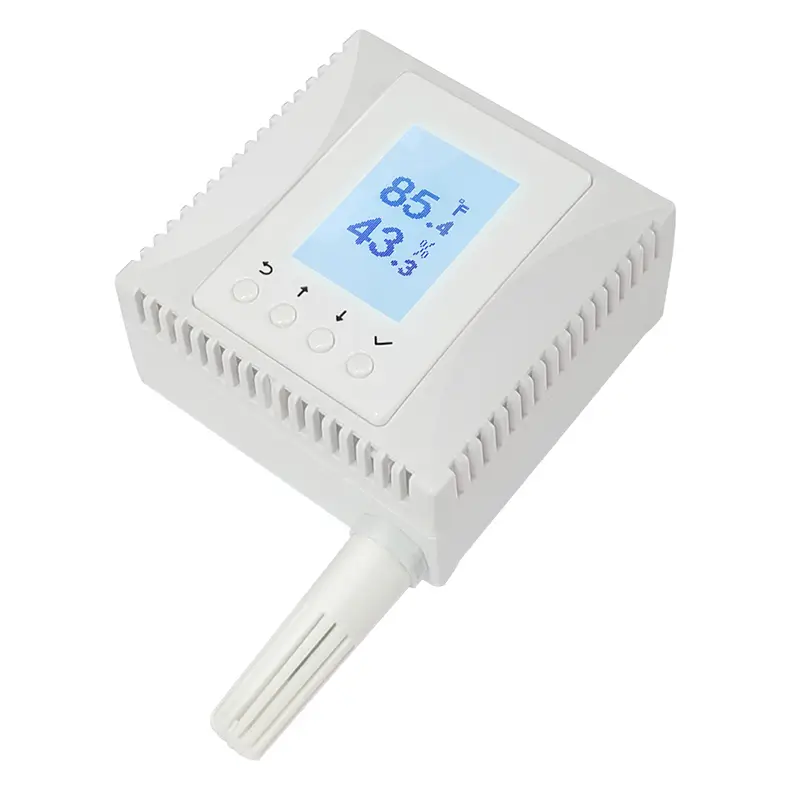
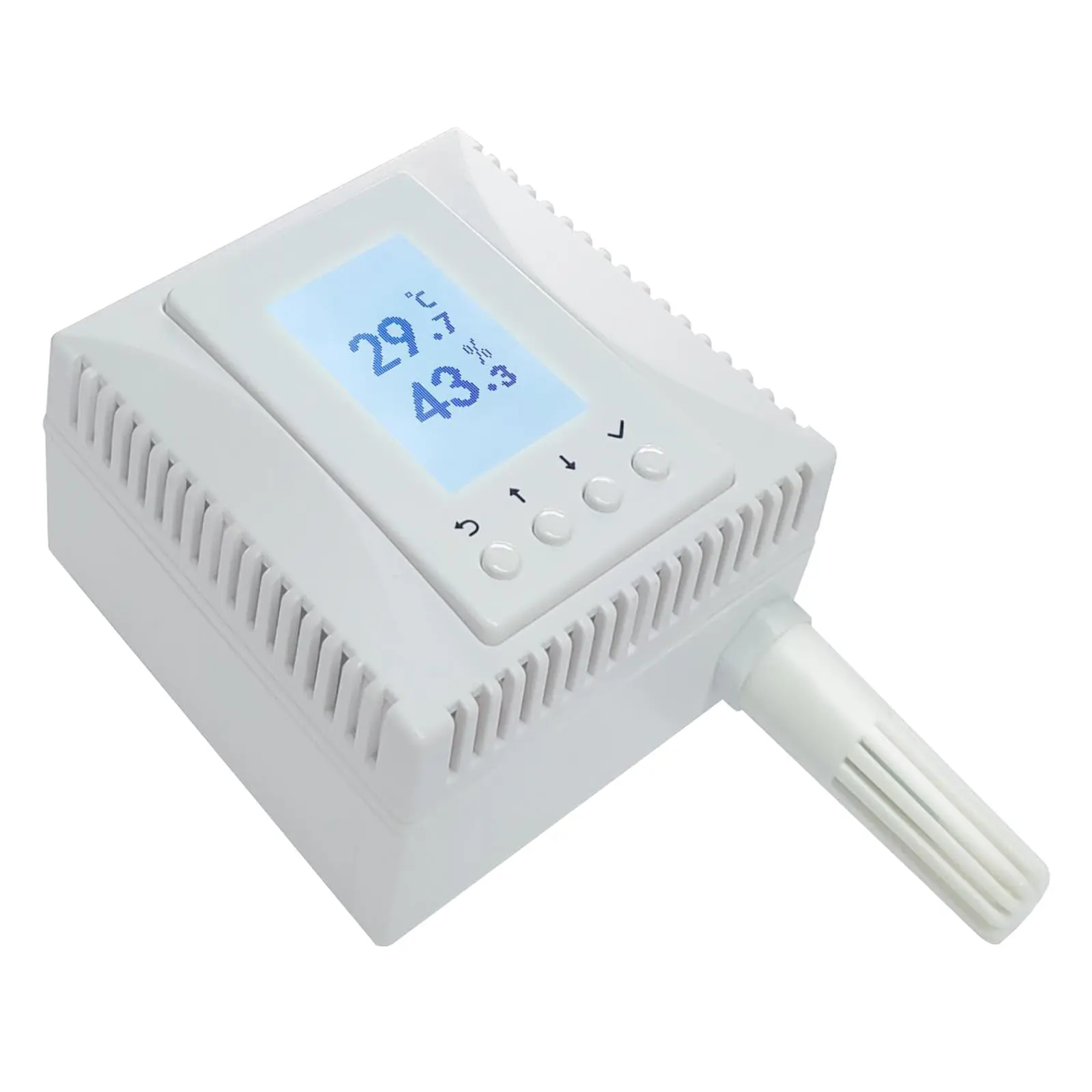
Elevate your environment tracking with MONIGEAR's professional-grade temperature and humidity sensor. Designed for reliability and seamless integration, this sensor delivers real-time, accurate readings to ensure optimal indoor conditions.
Key Features
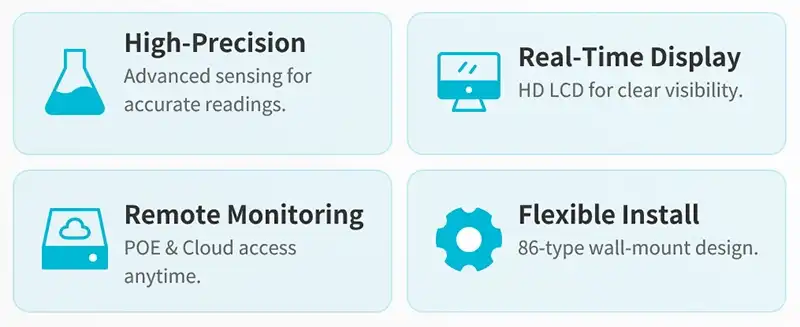
- Industrial-Grade Connectivity: Seamlessly integrates with MQTT, BACnet, SNMP, and Modbus TCP protocols, ensuring compatibility with existing building management systems and IoT platforms.
- A web service can be enabled to view sensor data directly through a browser. Support for the REST API protocol can also be enabled to return JSON data from the sensors. However, these two features are disabled by default for network security reasons, and can be enabled by configuration tool.
- Flexible Cloud or Local Operation: Sync with AWS/Azure/Tuya IoT cloud services or operate independently with your local server (e.g., Home Assistant), giving you complete control over your data.
- Advanced SNMP Support: Full compatibility with SNMP v1/v2/v3 and SNMP Trap v2c/v3, featuring enterprise-level security for critical infrastructure monitoring.
- Intelligent Alerts: Get instant email notifications and unlock IFTTT-powered automation for environmental anomaly responses. Custom email alert configurations are available on a single standalone device with no extra hardware required.
- PoE Power Efficiency: Simplify installation with Power over Ethernet (IEEE 802.3at compliant), eliminating the need for separate power cables and reducing maintenance complexity.
- High-Precision Sensing: Equipped with digital temperature and humidity sensors delivering industry-leading accuracy (Temperature: ±0.3°C, Humidity: ±3%), ensuring reliable environmental monitoring.
- User-Friendly Configuration: Intuitive graphical tool supports cross-platform operation, making setup and management accessible for both technical and non-technical users.
- Sleek, Durable Design: Compatible with standard 86×86 junction boxes, featuring a flame-retardant PC housing that meets stringent safety standards while complementing modern building aesthetics.
- Professional Certification: Certified through FCC/CE-EMC/ROHS, meeting the high standards and strict requirements of the market.
- Your Data, Your Control: MONIGEAR's sensor puts security first—whether cloud-connected or fully self-contained.
Typical Scenarios
For detailed information about the capabilities across all our Network Sensors, please visit our common features page.
Technical Specifications
| Measurement Range | Temperature: -30°C~85°C (-22°F~185°F); Humidity: 0-100% RH |
|---|---|
| Measurement Accuracy | Temperature: ±0.3°C @0-65°C (±0.54°F @32-149°F); Humidity: ±3%@10-90% RH |
| Communication Protocol | Supports multiple TCP/IP application layer protocols: MQTT/MQTTS, ModbusTCP, SNMP, BACnet, REST API, email etc. |
| Power Supply | POE Power: Compatible with IEEE 802.3at standard. Power supply can be customized to DC 5V or DC 12V on request. |
| Power Consumption | 0.5W |
| Operating Storage Temperature | -30~+85℃ (-22°F~185°F) |
| Operating Storage Humidity | 5~95% RH, non-condensing |
| Product Dimensions | 86*86*48 mm |
Frequently Asked Questions
Why does the MN-NTHM ship with a fixed default IP address (192.168.0.5) instead of DHCP?
There are two reasons for this design choice. First, in environments without a DHCP server — a common scenario during initial testing when the device is connected only to a basic network switch — enabling DHCP can cause a significant delay between power-on and when the device becomes configurable. Second, in industrial monitoring deployments, most customers prefer fixed IP addresses for devices installed at permanent locations. With DHCP, IP addresses can change after a power cycle, which may cause monitoring software to lose track of which sensor corresponds to which location, especially when multiple devices are deployed on the same network.
Can I view temperature and humidity readings directly through a web browser?
Web-based data viewing was not originally included in the product design due to network security considerations. However, based on customer feedback, support for REST API access returning JSON-formatted sensor data was added starting from the April 2026 firmware release. With REST API enabled, you can view sensor data as JSON directly in a browser. For devices manufactured after July 2026, a dedicated web page displaying live readings is also available via HTTP.
For security reasons, both the web page access and REST API features are disabled by default. You can enable them through the Monigear configuration tool, or via the Monigear mobile app in upcoming app updates.
Can I calibrate or adjust the temperature and humidity readings?
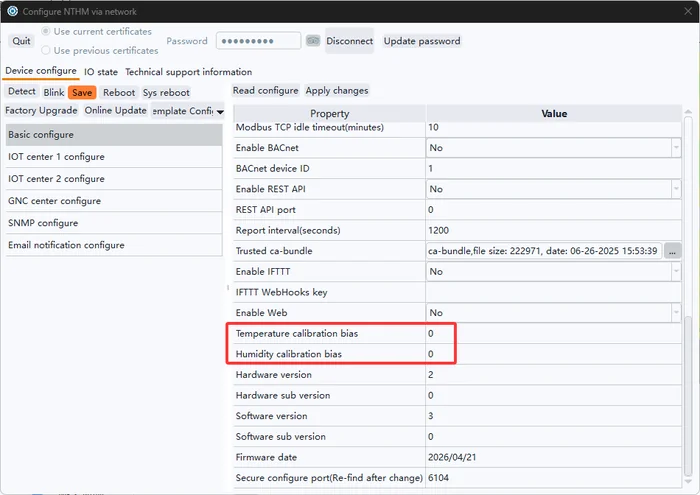
The MN-NTHM uses high-precision sensors with ±0.3°C temperature accuracy and ±3% RH humidity accuracy. Each batch undergoes consistency testing during production, and individual calibration is generally not required due to the excellent sensor accuracy. However, for customers with stringent calibration requirements, single-point offset adjustment is supported. In the configuration tool, under the "Basic configure" tab, you can set independent offset values for temperature and humidity to compensate for any systematic bias. For example, if readings are consistently 0.2°C high, you can set a temperature calibration bias of -0.2 to correct the readings.
Which direction should the sensor probe face during wall mounting? Are there alternative installation methods?
When wall-mounting the PoE version, we recommend installing the device with the sensor probe facing downward. This orientation provides better dust protection, which is important for long-term reliability in fixed installations. Additionally, the device's outer cover has one solid side and three vented sides; the solid side should face upward, as this design also helps minimize dust ingress into the enclosure.
For alternative mounting options (such as DIN rail mounting or other installation methods), please refer to the MN-NVOC product page — the same mounting accessories and methods are compatible with the MN-NTHM.
Is DC power input available as an alternative to PoE?
While the vast majority of customers use PoE (Power over Ethernet IEEE 802.3at/af) for its deployment simplicity, a DC-powered version is available for industrial applications where PoE is not available. The DC version uses a different power board and supports a DC input range of 9V–28V. DC-powered units are custom-built to order — please contact us by email to specify your DC power requirement. Pricing is the same as the PoE version, but lead times may be longer since DC units are produced in smaller quantities and typically not stocked as standard inventory.